'/%3E%3C/svg%3E)

A Journey with My Book “Divino e Stellato”
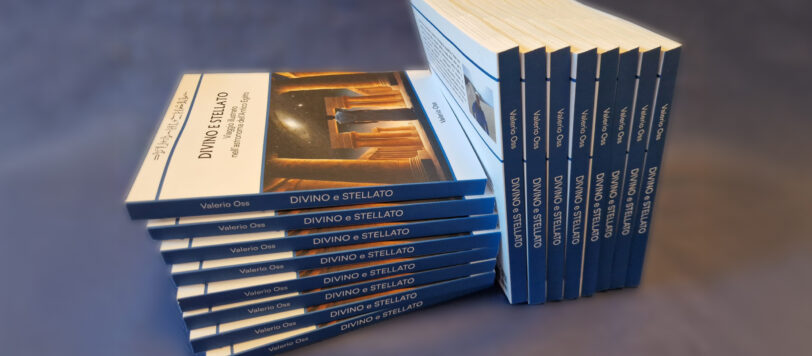
Writing Divino e Stellato has been, for me, like embarking on a journey back through time, with my gaze always fixed on the sky. It was not a race to unveil hidden secrets, but a slow and respectful path: made of silences, of readings, of nights spent between telescopes and ancient texts, between photographs of starry ceilings and hieroglyphs carved in stone.
Each chapter of this book was born like a constellation: by connecting distant fragments — inscriptions, images, insights, scientific studies — to create a figure capable of speaking to us today, men and women of the 21st century. In those symbols, in those sacred texts, and in the astronomical representations of Ancient Egypt, I found not only traces of celestial knowledge, but also the reflection of a humanity deeply aware of its place in the cosmos, with both humility and consciousness.
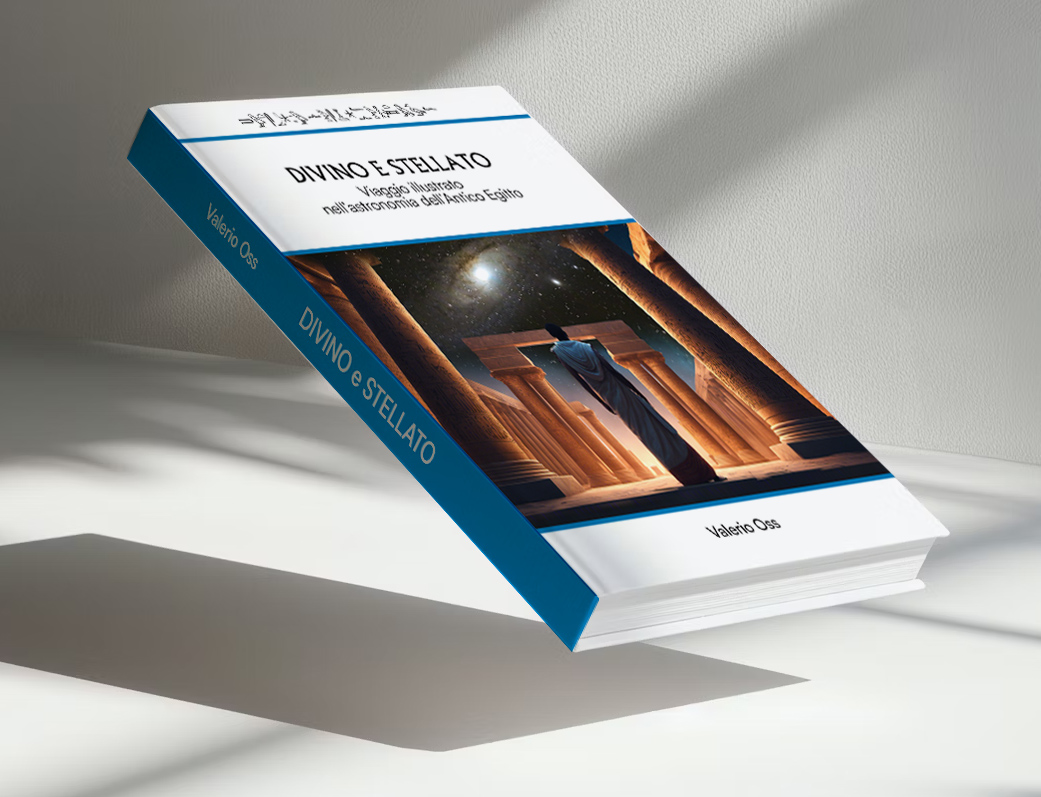
The Egyptians did not study the stars to dominate them, but to attune themselves to their rhythm. For them, time was the very breath of the sky. And while the Greeks left us with formulas and mechanical models, Egypt handed down a deeper message: observing the sky is also a spiritual act.
Over more than two years of research and writing, I realized how difficult — and yet essential — it is to try to think like a civilization that did not need numbers to be considered scientific. Theirs was an astronomy of balance, of Maat: what we might today call “cosmic sustainability.” An ancient concept, but strikingly relevant, in a world that seeks balance not only on Earth but within the entire universe that hosts us.
Carl Sagan reminded us that we are a small blue dot suspended in a ray of light. The Egyptians, without telescopes or space probes, had already grasped that the sky was not a decorative backdrop, but the very fabric that sustains life, the waters of the Nile, natural cycles, and human rituals. Today we can measure stellar distances with extreme precision, yet we risk forgetting the sense of connection they preserved.
Writing this book has been, for me, a constant dialogue with the ancients: they traced maps with symbols, I with astronomical software; they carved stars into temples, I capture them with modern telescopes. But the wonder remains the same, universal and timeless. It is the same wonder I see in a child’s eyes when I show them the Milky Way, and the same wonder that has guided me on every page of Divine and Starry.
If those who read these pages feel even the slightest shiver before the sky — whether real or painted on a Theban ceiling — then I will know that my work has truly found its meaning.