


Categories: News
Tags: 3C 120 active galaxies relativistic jets supermassive black holes XRISM
Posted by: ossvale
Comments:0
Where a cosmic jet begins: new clues from the black hole in 3C 120
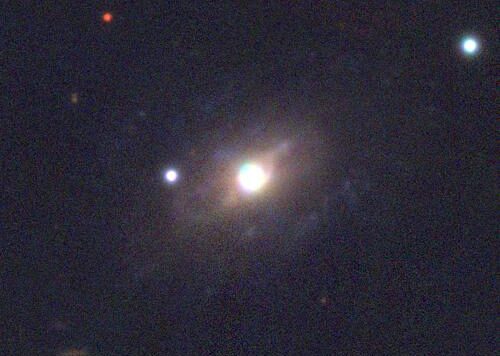
Combining X-ray spectroscopy with radio observations, astronomers have investigated the inner region that may allow a rapidly feeding black hole to launch a powerful jet.
Understanding a cosmic jet requires two complementary views: one of the matter approaching a black hole, and another of the outflow travelling away from it. A study of the active galaxy 3C 120 brings those views together, using the XRISM space telescope and international radio telescope networks.
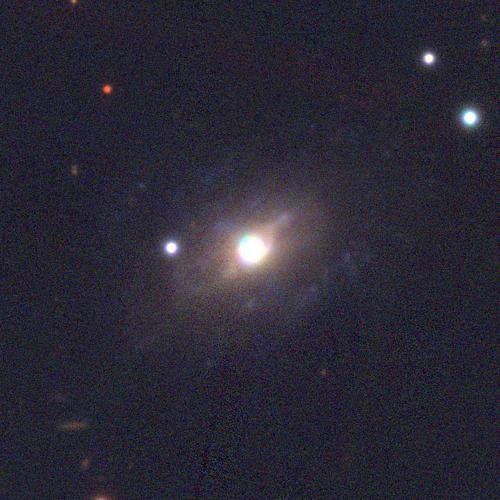
The findings suggest that the accretion disk changes structure close to the centre. Its relatively cool, thin component appears to end at around twenty gravitational radii, giving way to a hot, thick inner flow. Researchers inferred this transition from the distorted shape of an iron emission line measured in X-rays.
Radio observations provide a separate clue. Extrapolating the jet’s narrowing profile towards the centre places its origin within a scale consistent with that hot inner region.
Such an environment could support the magnetic fields needed to draw energy from the black hole’s rotation. The results strengthen the case for the Blandford–Znajek mechanism, while leaving questions about the magnetic configuration and its wider applicability. Observations of other systems will help establish how common this arrangement is.
Sources: Noda et al., The Astrophysical Journal Letters (arXiv preprint); Tohoku University, October 20, 2026; Media INAF, October 22, 2026.