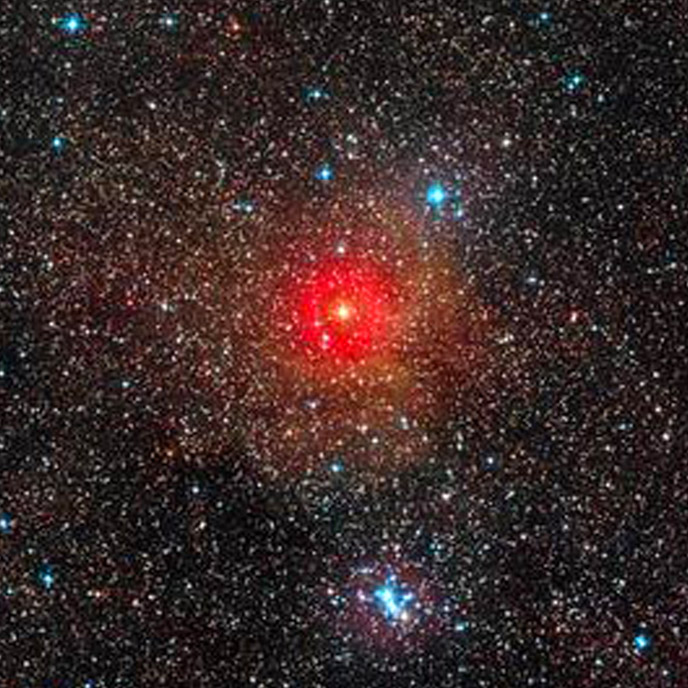


Perhaps the Betelgeuse mystery is solved, the star would be obscured by an eruption
From the Bits of Universe archive — 16/08/2020
A gigantic eruption would be the most probable cause of the sudden decrease in brightness of the star Betelgeuse, which at the turn of 2019 and 2020 had caused astronomers to worry enough to suspect an imminent explosion. Its mystery was solved by the Hubble Space Telescope, owned by NASA and the European Space Agency (ESA): thanks to its ultraviolet observations, it was possible to identify the expulsion from the stellar surface of an enormous quantity of incandescent material, which it would then form a cloud of dust responsible for the clouding. The study results are published in The Astrophysical Journal. Here the direct link to the article
According to the researchers ‘reconstruction, from September to November 2019 a huge mass of ultra-hot plasma rose from the surface of Betelgeuse to head towards its external atmosphere: from there it continued to travel for millions of kilometers, cooling and turning into a’ immense cloud of dust, the very one that for months obscured about a quarter of the surface of the red supergiant, making it almost unrecognizable until April.
“With Hubble we observed the material as it left the visible surface of the star and receded through its atmosphere, before the dust formed that obscured it,” explains Andrea Dupree, associate director of the Harvard-Smithsonian Center for Astrophysics. in Cambridge. “We could thus see the effect of a dense, hot region moving outward from the southeastern portion of the star. It was material two to four times brighter than the star’s normal brightness. Then, about a month later, the southern hemisphere of Betelgeuse darkened noticeably as the star became paler. We think it is possible that the emission detected by Hubble produced a dark cloud “