

Categories: News
Tags: debris discs ESO J1328−1450 planetary systems white dwarfs X-shooter
Posted by: ossvale
Comments:0
Two rings around a white dwarf reveal the remains of a planetary system

Spectra of J1328−1450 reveal two distinct regions of gas. Two surviving rocky bodies may be supplying this material long after their host star’s transformation.
A star’s final evolutionary stages need not erase its planetary history. Around the white dwarf J1328−1450, approximately 1,600 light-years away, astronomers have uncovered an unusual arrangement: two concentric gas rings within a wider dusty disc. The international team is led by Nicola Pietro Gentile Fusillo of the University of Trieste, also affiliated with INAF.
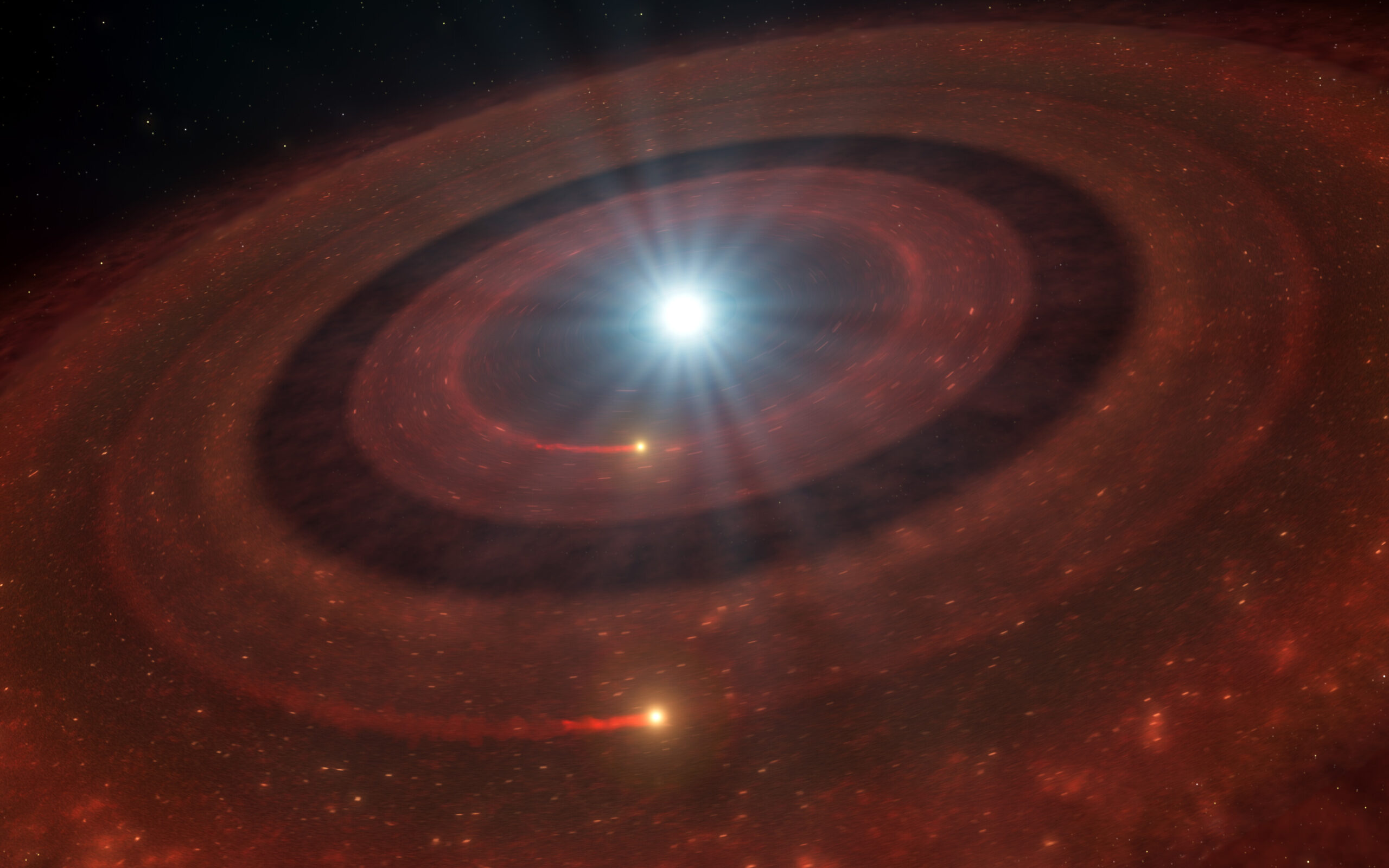
The evidence comes from X-shooter, a spectrograph on ESO’s Very Large Telescope. Some emission lines display four peaks, consistent with two rings orbiting at different speeds. Rather than a resolved photograph of the rings, this is a reconstruction from their spectral signatures.
Their chemistry also differs: magnesium is depleted relative to calcium in the outer ring. This could reflect material from different parent bodies, or from different layers of an originally differentiated body.
The researchers propose that two surviving planetesimals generate gas through interactions with surrounding dust. These bodies have not been detected directly, and estimates of their possible sizes depend on physical assumptions. The gap inferred in the gas does not establish an equivalent gap in the dust. Understanding this arrangement could help explain how planetary debris evolves around stellar remnants—and illuminate possible outcomes for systems such as our own.
Sources: A double debris disc around a white dwarf sculpted by two planetary bodies, Nature Astronomy, October 26, 2026; ESO, October 27, 2026; University of Trieste; Media INAF.