

Categories: News
Tags: cosmology dark matter ESA Euclid galaxies gravitational lensing
Posted by: ossvale
Comments:0
Euclid catalogues more than 900 million galaxies: building a 3D map of the cosmos
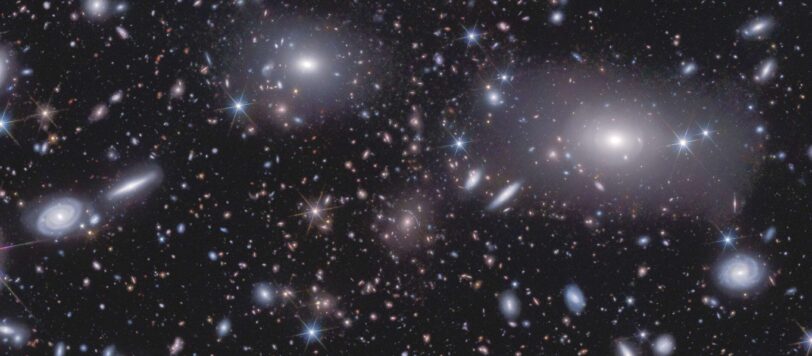
In Euclid’s image of Abell 3128, two galaxy clusters appear to occupy the same patch of space. Their overlap is a trick of perspective. A picture tells us where to look in the sky. Turning that view into a three-dimensional map also requires an estimate of how far away the galaxies are.
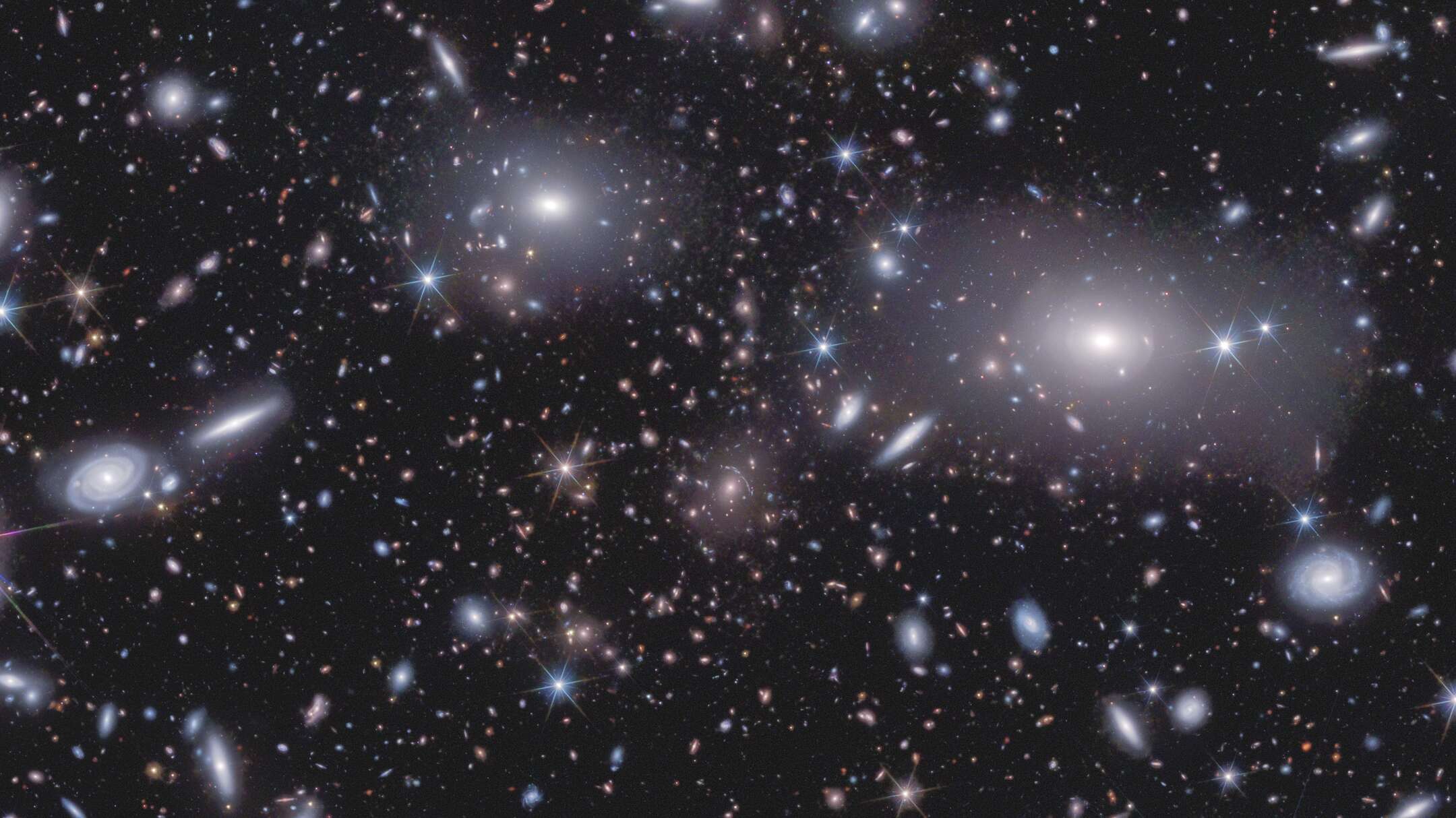
Released on 12 November 2026, DR1‑Foundation catalogues more than 900 million galaxies and includes spectra for over 160 million sources. If a spectral line can be identified, its shift towards longer wavelengths helps astronomers estimate the source’s distance. Having a spectrum, however, does not mean a precise distance has already been measured.
The release also lists around 15,000 strong gravitational lens candidates. In such systems, foreground mass can bend the light of a distant galaxy into arcs or multiple images. The pattern gives astronomers a way to weigh the foreground object, including matter that gives off no light. The full release, scheduled for June 2027, will add measurements of subtler distortions from weak lensing and other products needed for cosmological analyses.
Sources